
KMUN I: Diversity in Unity
- Narusorn (Noah) Lindsay
- Feb 12
- 7 min read

By Noah Lindsay (Grade 12) & Jay Cheung (Grade 11)


Opening Ceremony: “If we do not want to die together in war, we have to live together in peace,” quotes head of Kaohsiung American School, Jim Laney, during his speech in the opening ceremony of the first ever Kaohsiung Model United Nations conference. The room fills with tension and excitement as hundreds of debaters from Taipei, Hsinchu, Tainan, and Kaohsiung await to engage in debate that is not only riveting, but also undeniably relevant to today’s modern social and political landscape.
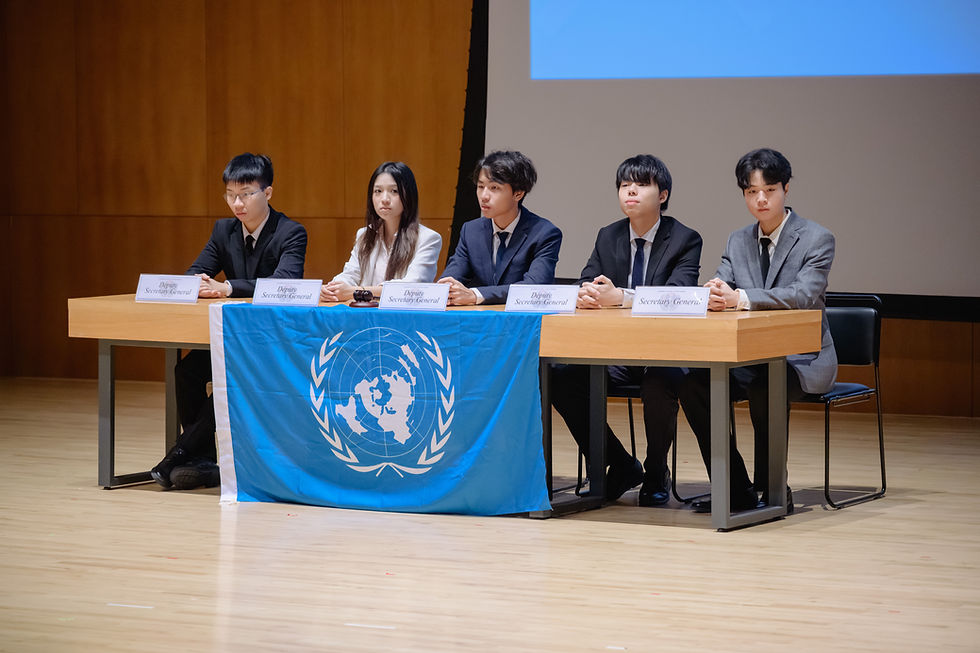
Secretariat Gavin Lo stresses during his address that the theme of this year’s conference is Unity in Diversity, where committees will be facing issues regarding striking a balance between contesting perspectives; because as Gavin also stresses later on, unity is peace. The deputy secretariats Daniel Chen and Jonathan Chen give speeches like seasoned politicians and set the tone for the opening video, which is a dramatic overview of the world’s current political climate: at risk of calamity, and in need of more understanding and implementation of change.
Founder of Ghost Island Media, Emily Wu, gave a speech on what makes Taiwan important in the scheme of the United Nations. Where is its place in the world? She talks in broad strokes about how her media company is important because they focus on “urgent social issues and aims to strengthen cultural exchange”, which coincides with the mission of our conference: Unity in Diversity.

At the end of the opening conference, the audience’s mind is drawn back to something said during Mr. Laney’s speech: “Diplomacy is not about winning an argument, it’s about diversity and perspective,” followed up later with “Today, you are many voices with one purpose,” reminding delegates, chairs, advisors, and all participants alike that at the heart of this conference, there is compromise and fruitful discussion. Committees:
ICJ The ICJ is a high school committee that focuses on international issues, hearing only the legal disputes between countries instead of individuals, organizations, or companies. In this committee, Ukraine has applied for the application of the International Convention for the Suppression of the Financing of terrorism, as well as for the Elimination of all forms of Racial Discrimination against Russia regarding the occupation of the region of Crimea by Russia.

Ukraine claims Russia financed armed separatist groups in Eastern Ukraine, and discriminated against Crimean Tatars and ethnic Ukrainians in Crimea in terms of restricting Ukrainian language education in Crimea, as well as suppressing Crimean Tatar institutions. On the other side, Russia argues that there is no direct evidence linking Russia to specific terrorist acts, and that its policies in Crimea were for integration, and not discrimination.
ICJ advocates Donggeon Kim and Jerry Tsai engaged in a fierce battle of rhetoric against Anderson Kao and Sean Woodruff. It seems like an uphill battle for the Ukraine team.
The International Court of Justice is host to the most heated debates, as it often involves back-and-forth verbal transactions that are rapid-fire. In the entirety of KMUN, this committee seems to be the one with the most chemistry and engagement, with everyone on the edge of their seats.
PS: they concluded closing statements with a rap battle.
GA 1 GA1 is a middle school committee that focuses on issues (0701): Regulating autonomous weapons and AI in warfare, and (0702): Addressing the growing risk of nuclear weapons deployment. During lobbying time, the assigned countries already have great chemistry, despite a lack of the refined experience that other committees may have.

Co-Chair Zoe Cowie finds the topics that are being debated interesting, as they go into depth and are controversial. As a middle schooler from KAS, she believes that the conversations are easy-going because most of the participants are middle schoolers in KAS as well, so there is a level of comfort that is omnipresent throughout the entire debate as everyone “already knows each other”.

The chair, Joel Shih, gets along with the delegates like he is from KAS, despite being from PAS. He is able to facilitate debate in a crowd that is, at the very least “very lively”, and involves some joking around and “snuggling”.
When it comes to the actual debate, the delegates buckled down to the point quite fast. The delegate of Egypt opens up the first resolution, urging fellow countries to regulate and monitor AI usage in warfare. This resolution stresses accountability and strict rules regarding the use of such weaponry, and creates a framework of sorts for the production and implementation of these devices. This resolution is backed by Egypt and others, and contested mainly by South Africa, who makes an amendment, and India who raises multiple POIs.
The debate starts off slow as everyone tries to find their voices, but eventually the momentum builds and amendments are made that eventually lead to a polished final draft, with all voices being heard and the chairs providing clarification and support when needed. Sure, it’s not as fast as some of the more advanced committees, but it leads to an ideal solution nonetheless.
SC1
The security council - operating slightly differently than a standard General Assembly - contains five permanent members and the rest as non-permanent members, with the five permanent members holding specific veto rights that the rest of the committee do not have. The issues being debated are (0101): The issue of the deteriorating security and humanitarian situation in the Sahel region, and (0102): The Situation in Ukraine and Its Global Security Implications.

The President of the committee, Shannon Wang Lee, comments on the issues being debated, saying she hopes the takes are “nuanced” and that the size of the committee should allow for more equal representation. The Deputy President, Haru Shih, says she thinks the issues are a lot of fun and are very relevant in today’s political landscape.

Security Council I opens up with very concise and logical reasoning, with every single delegate displaying a certain level of familiarity with the structure of debate, allowing it to flow smoothly. Placards are quickly raised, almost like a competition, and opinions are much more split than in most of the other committees with most votes being a close call.
The first resolution, main-submitted by France, urges members to protect civilians and citizens, and encourages more efficient use of economic resources to facilitate agriculture and other humanitarian rights in a region that currently faces a violent diaspora. Amendments are made quickly, with contentions being made by Sierra Leone and the United States, and are ultimately reaching toward the same thing: safety and prosperity in a region that so very clearly needs it.
Tense and effective, Security Council 1 proves to house one of the most fruitful and efficient debates at this year’s Kaohsiung Model United Nations I.

GA4
For GA4, they are contending the issue (302): Establishing a framework to ensure equal access to programs for refugees and migrant children. The migrant problem is especially important as more than 48.8 million children are displaced globally, with around 19.1 million children being refugees or asylum-seeking children. These numbers are exacerbated by the fact that many of these children suffer from malnutrition, interrupted or nonexistent education, and lack any form of legal documentation proving their existence, which prevents them from accessing basic services. As a result, many are unable to enroll in schools, receive healthcare, or benefit from social support programs.
In GA4, students are committed, talkative, and energetic. The references made to specific recent events, such as the death of Charlie Kirk, Trump memes, and the persuasiveness of the delegate of Israel, made GA4 an overall fun and wildly entertaining Assembly, full of interesting and compelling delegates.

HRC
The Human Rights Council specializes in fighting for - you guessed it - human rights. This helps facilitate a special passionate characteristic within the delegates that might be present in other committees, but is the most prominent here. They’re debating on (0501): The issue of combating child marriage, and (0502): The question of addressing Tensions between Universal Human Rights and Cultural Practices. The President of this committee, Ashley Tan, specifies that child marriage is an under-addressed issue in countries like India and Pakistan, and that the people in the committee seem tightly-knit and ready to engage. President Jonathan Shih is “personally a big fan of human rights”, and the human rights council specifically, as it usually allows for a controversial debate that tends to get heated. Like previously mentioned, he states that the delegates are passionate and always know what to say. Deputy president Melody Tan emphasizes that a lot of countries have weak enforcement that don’t allow for proper regulation of issues such as child marriage, and that there are a lot of stakes. She also mentions the inclination the delegates have toward the first issue rather than the second.

Delegates are always eager to speak, and are very familiar with both the resolutions and their country’s stances on the topics being discussed. The resolution on the deteriorating security and humanitarian situation in the Sahel Region is padded out clauses that are relevant and concise, yet are countered with amendments that are even more effective.
Allen Ko: Human Rights Council is advocating for those who don't have their deserved rights.
The debate today is good, exchanging ideas is peaceful and that’s what Model United Nations is all about. Refinement from different pieces of feedback to create a feasible solution, suited for all.
Jonathan Shih: The debate started slowly, but now everyone is very excited to participate.
SC2
SC2 is about issue (0802): The issue of water scarcity and transboundary water disputes. The President is Sophia Chen, and the Deputy President is Zara Cowie. The issue of water scarcity is due to the rapid increase in population growth and climate change, with the Security Council discussing the issue from a security and political perspective, as it drives instability and disputes. This is especially crucial as 4 billion people face severe water scarcity at least one month a year, with climate change leading to a less reliable supply of water.

Mr. Torrance, an advisor of the different conferences, stated that the atmosphere was great. Despite being a middle school Counsel, the students were able to establish a good balance between being serious and having fun, especially as many students weren’t very familiar with MUN. The energy was great, and the chairs did a very good job at having the students stay on task. Definitely a very promising start for young delegates.

CLOSING REMARKS: Rushed to the auditorium with their newly made friends, delegates formed groups in clusters and seated to hear the conclusion of this wonderful experience. Head of School Jim Laney gave his closing remarks, emphasizing the refrain “Unity in Diversity”, whilst highlighting the hard work and dedication put in by the organizers and participants of this event.
Deputy Secretariat Charles Chung thanked his fellow officers for their dedication, while Daniel Chen introduced The Press Team who presented their closing ceremony video. ICJ gave their triumphant closing verdict, and every committee wrapped up with a heartfelt speech from their respective chairs. It was clear: KMUN I was not only an educational and insightful experience, it was one to be remembered, and a founding anchor for many more KMUN conferences to come.
Through all of the intense debate, delegates found compromise. Through tension and unfamiliarity, delegates found friendship. Through diversity, everyone finds unity.


Very well done, Messrs Lindsay and Cheung!!👍